Types of Thyroid Cancer: A Complete Guide for Patients in Singapore
- Vyas Prasad
- Apr 9
- 9 min read

Updated: 4 days ago
There are four main types of thyroid cancer — papillary, follicular, medullary, and anaplastic — each with different biological behaviour, treatment approach, and prognosis. Papillary thyroid cancer, the most common type, has an excellent long-term prognosis with appropriate surgical and radioiodine treatment, while anaplastic thyroid cancer is rare but aggressive and requires urgent multidisciplinary management.
There are four main types of thyroid cancer: papillary, follicular, medullary, and anaplastic — with very different prognoses
Papillary thyroid cancer is by far the most common and has an excellent long-term outlook
Anaplastic thyroid cancer is rare but aggressive and requires urgent specialist management
Understanding the type of cancer determines the treatment pathway and follow-up plan
Being told you may have thyroid cancer is frightening. The word "cancer" carries enormous weight, and it is natural to feel overwhelmed, anxious, or unsure of what happens next. The good news — and it is genuinely good news — is that thyroid cancer is among the most treatable of all cancers. The vast majority of patients go on to live normal, healthy lives after treatment.
This guide explains the main types of thyroid cancer in plain language: how they are found, what treatment involves, and what life looks like afterwards. It is written for patients who want to understand their diagnosis before their specialist consultation — not as a substitute for medical advice, but as a foundation for a more informed conversation.
What is the thyroid gland?
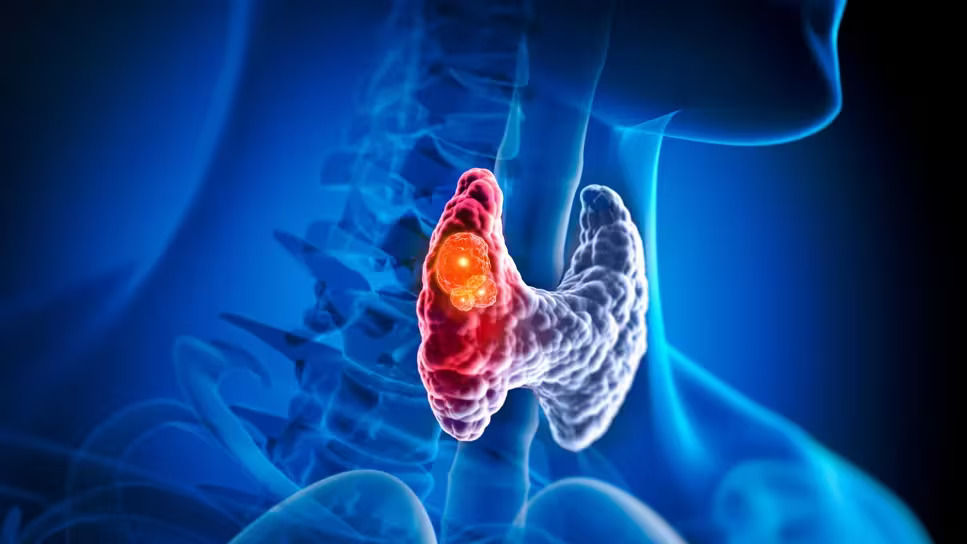
The thyroid is a small, butterfly-shaped gland sitting at the base of your neck, just below the voice box. Despite its small size, it plays a major role in regulating how your body functions. It produces hormones that control:
Metabolism — how your body converts food into energy
Heart rate and blood pressure
Body temperature
Growth and development
Most thyroid lumps (nodules) are entirely benign — they are found in up to 50% of adults on ultrasound and the overwhelming majority require nothing more than monitoring. A small proportion contain cancerous cells and need specialist assessment and treatment.
.
How is thyroid cancer usually found?
In Singapore, thyroid cancer is often discovered in one of three ways:
Incidentally on imaging — picked up on a scan (ultrasound, CT, or MRI) done for a completely unrelated reason, such as neck pain or a routine health screening
As a lump in the neck — felt by the patient or their doctor during examination
Through investigation of thyroid nodules — when a known nodule changes in size or appearance on follow-up ultrasound
What tests are used to assess a thyroid lump?
If a thyroid nodule is found, your specialist will typically arrange:
Ultrasound of the neck The first and most important test. Ultrasound can assess the size, composition, and features of a nodule — certain characteristics suggest a higher or lower likelihood of malignancy. The findings are usually reported using a standardised system (such as TIRADS) to guide next steps.
Fine Needle Aspiration Cytology (FNAC) A small needle is passed into the nodule — usually under ultrasound guidance — to collect a sample of cells for laboratory analysis. It is a quick, minimally uncomfortable procedure done in the clinic. Results are reported using the Bethesda classification system:
Bethesda Category | What it means | Approximate cancer risk |
I — Non-diagnostic | Not enough cells to assess | Repeat FNAC recommended |
II — Benign | Almost certainly non-cancerous | Very low (0–3%) |
III — Atypia of undetermined significance | Borderline result | ~10–30% |
IV — Follicular neoplasm | May be benign or malignant | ~25–40% |
V — Suspicious for malignancy | Likely cancerous | ~60–75% |
VI — Malignant | Cancer confirmed | >97% |
If your result falls in categories III or IV, your surgeon will discuss the options — which may include repeat sampling, molecular testing, or a diagnostic operation to examine the nodule properly.
Thyroid function blood tests These check whether the gland is producing the right amount of hormone. Most thyroid cancers do not affect thyroid function, but these tests form part of the standard assessment.
Further imaging In selected cases — particularly for larger tumours or when spread to lymph nodes is suspected — a CT scan of the neck and chest, or a nuclear medicine scan, may be arranged.
The four main types of thyroid cancer
Thyroid cancers are grouped by the type of cell they arise from. Each behaves differently and is managed differently although surgical treatment is usually indicated.
Papillary thyroid cancer
Papillary thyroid cancer is by far the most common type, accounting for around 80–85% of all thyroid cancers. It most often affects younger and middle-aged adults, and is more common in women.
Despite sometimes spreading to lymph nodes in the neck, papillary thyroid cancer grows slowly and has an excellent long-term prognosis. Ten-year survival rates are very high, particularly when the cancer is caught early and confined to the thyroid.
Treatment typically includes:
Surgery to remove part or all of the thyroid gland (hemithyroidectomy or total thyroidectomy)
Removal of affected lymph nodes if spread is confirmed
Radioactive iodine therapy in selected cases (see below)
Long-term follow-up with blood tests (thyroglobulin levels) and periodic ultrasound
Follicular thyroid cancer
Follicular thyroid cancer is the second most common type, seen more often in middle-aged and older adults. Unlike papillary cancer, it tends not to spread to lymph nodes — instead, if it does spread, it more commonly travels via the bloodstream to the lungs or bones.
An important feature of follicular thyroid cancer is that it cannot be definitively diagnosed on FNAC alone — the cytology may suggest a "follicular neoplasm" (Bethesda IV), but distinguishing a benign follicular adenoma from a follicular cancer requires surgical removal and examination of the full nodule. This is one reason surgery is often recommended for Bethesda IV results.
When caught early, follicular thyroid cancer also carries a good prognosis.
Treatment is similar to papillary cancer:
Total thyroidectomy in most cases
Radioactive iodine therapy in intermediate and high-risk cases
Lifelong thyroid hormone replacement and regular follow-up
Medullary thyroid cancer
Medullary thyroid cancer arises from the C-cells of the thyroid, which produce a hormone called calcitonin (not the usual thyroid hormones). It accounts for around 3–5% of thyroid cancers.
A key distinguishing feature is that around 25% of medullary thyroid cancers are hereditary — occurring as part of a genetic syndrome called MEN2 (Multiple Endocrine Neoplasia type 2). For this reason, genetic testing and family screening are an important part of management.
Key points:
Blood calcitonin levels are elevated and used both for diagnosis and to monitor treatment response
Genetic testing (RET gene mutation) is recommended for all patients
First-degree relatives may need genetic counselling and screening
Radioactive iodine is not effective for this type — surgery is the primary treatment
Management is best coordinated by a multidisciplinary team including an endocrinologist, geneticist, and surgeon
Anaplastic thyroid cancer
Anaplastic thyroid cancer is rare — accounting for less than 2% of thyroid cancers — but is the most aggressive type. It typically affects older adults and often presents as a rapidly enlarging mass in the neck, sometimes causing difficulty breathing or swallowing.
This type requires urgent specialist assessment. Management involves a multidisciplinary team and may include surgery, radiotherapy, targeted systemic treatments (including newer immunotherapy agents), or a combination. The focus is on controlling the disease and maintaining quality of life. Outcomes have improved in recent years with the development of targeted therapies for specific genetic mutations.
Staging — understanding how far the cancer has spread
Once thyroid cancer is confirmed, your team will stage it. Staging assesses:
The size of the primary tumour
Whether cancer has spread to lymph nodes in the neck
Whether it has spread to distant sites (lungs, bones)
For papillary and follicular thyroid cancers, staging also takes age into account — patients under 55 are generally staged differently, reflecting the better prognosis in younger patients.
Staging guides decisions about:
How much of the thyroid should be removed
Whether lymph node surgery is needed
Whether radioactive iodine is recommended
The intensity and frequency of follow-up
Understanding radioactive iodine therapy
Radioactive iodine (RAI, also called I-131) is a targeted treatment used after thyroid surgery for some patients with papillary or follicular thyroid cancer. The thyroid gland — and thyroid cancer cells — have a unique ability to absorb iodine. Radioactive iodine exploits this to destroy any remaining thyroid tissue or cancer cells after surgery.
What does treatment involve?
Taken as a single capsule or liquid dose, usually as an outpatient or with a short inpatient stay
Patients are required to follow a low-iodine diet for 1–2 weeks beforehand
Some radiation precautions are needed for a few days after treatment to protect others
Not every patient with thyroid cancer needs RAI. Low-risk papillary cancers confined to the thyroid may be managed with surgery alone. Your specialist will discuss whether RAI is recommended based on your specific staging and risk profile.
Why a laryngologist-surgeon matters for thyroid cancer
The recurrent laryngeal nerve — the nerve that controls vocal fold movement — runs in close proximity to the thyroid gland on both sides of the neck. Injury to this nerve during thyroid surgery can cause hoarseness, a weak or breathy voice, or in rare cases breathing difficulty.
As a subspecialty laryngologist (a surgeon who specialises in the voice as well as the neck), Dr Prasad has an intimate understanding of this nerve's anatomy and behaviour. Intraoperative nerve monitoring is used throughout thyroid surgery to continuously assess nerve function in real time, providing an additional layer of protection.
If any voice change does occur after surgery, Dr Prasad is also able to assess and manage this directly within the same practice using laryngoscopy and voice rehabilitation — without the need for referral elsewhere.
Life after thyroid cancer treatment
For most patients with papillary or follicular thyroid cancer, treatment is followed by a return to normal daily life. Here is what to expect:
Thyroid hormone tablets After total thyroidectomy, lifelong thyroid hormone replacement (levothyroxine) is required. In some patients with thyroid cancer, the dose is kept slightly higher than normal — a strategy called TSH suppression — to reduce the chance of recurrence. Dose is adjusted based on regular blood tests.
Long-term follow-up Follow-up typically involves:
Blood tests for thyroglobulin (a tumour marker) and TSH at regular intervals
Periodic neck ultrasound to check for any recurrence in the neck
Whole body scans in selected cases
Calcium levels After total thyroidectomy, the parathyroid glands — which sit behind the thyroid and regulate calcium — can sometimes be temporarily affected. Low calcium (causing tingling in the fingers or around the mouth) is managed with calcium and vitamin D supplements, which are usually tapered and stopped once the glands recover.
Voice and scar Any voice changes in the immediate post-operative period usually settle within weeks. The incision is placed within a natural skin crease in the lower neck and typically heals to a fine, flat scar that fades significantly over six to twelve months.
When should you see a specialist?
Seek a specialist ENT or thyroid assessment if you notice:
A new or growing lump in the neck
Persistent hoarseness or voice change lasting more than three weeks
Difficulty swallowing or a sensation of something stuck in the throat
Difficulty breathing or unexplained breathlessness
A family history of thyroid cancer or a known genetic syndrome (MEN2)
Early assessment allows for accurate diagnosis and, where needed, timely treatment.
Frequently asked questions
Is thyroid cancer curable? For papillary and follicular thyroid cancer — the two most common types — the answer is yes in the majority of cases, particularly when detected early. Ten-year survival rates for these cancers are very high. Medullary and anaplastic thyroid cancers are rarer and carry a more variable prognosis, though outcomes have improved with advances in targeted treatments.
Will I need radioactive iodine? Not necessarily. RAI is recommended for intermediate and high-risk papillary and follicular thyroid cancers, but many low-risk cancers are managed with surgery alone. Your specialist will explain whether RAI is part of your treatment plan based on the staging and pathology of your cancer.
Can thyroid cancer come back? Recurrence is possible, particularly in the first few years after treatment, which is why long-term follow-up is important. Most recurrences are detected early through routine blood tests and ultrasound, and can be treated effectively. The risk of recurrence varies by cancer type, stage, and whether RAI was used.
Will surgery affect my voice? Temporary voice changes after thyroid surgery are common and usually resolve within days to weeks. Permanent voice change from nerve injury is uncommon in experienced hands and is reduced further with intraoperative nerve monitoring. Because Dr Prasad is also a laryngologist, any voice concern after surgery can be assessed and managed directly.
What is the scar like? The incision is made within a natural skin crease in the lower neck. It is typically five to eight centimetres in length and, with good wound care, heals to a fine, pale scar that becomes much less noticeable over six to twelve months.
Do I need to tell family members if I am diagnosed? For most thyroid cancers (papillary and follicular), there is no need for family screening as these are not typically hereditary. Medullary thyroid cancer is the exception — if a RET gene mutation is identified, first-degree relatives should be offered genetic counselling and testing.
Arranging a consultation in Singapore
Whether you have been referred after an incidental finding, are waiting for FNAC results, or simply want a specialist opinion on a thyroid lump, Dr Vyas Prasad provides clear, evidence-based assessment and surgical care at Camden Medical Centre, 1 Orchard Boulevard, Singapore.
Dr Prasad's dual expertise as a thyroid surgeon and laryngologist means that all aspects of your care — from diagnosis through surgery to voice rehabilitation if needed — can be managed within a single practice.



Need to know for thyroid cancer sufferers. Thanks . Good blog.
Informative article
Thank you for the insightful article
Good information